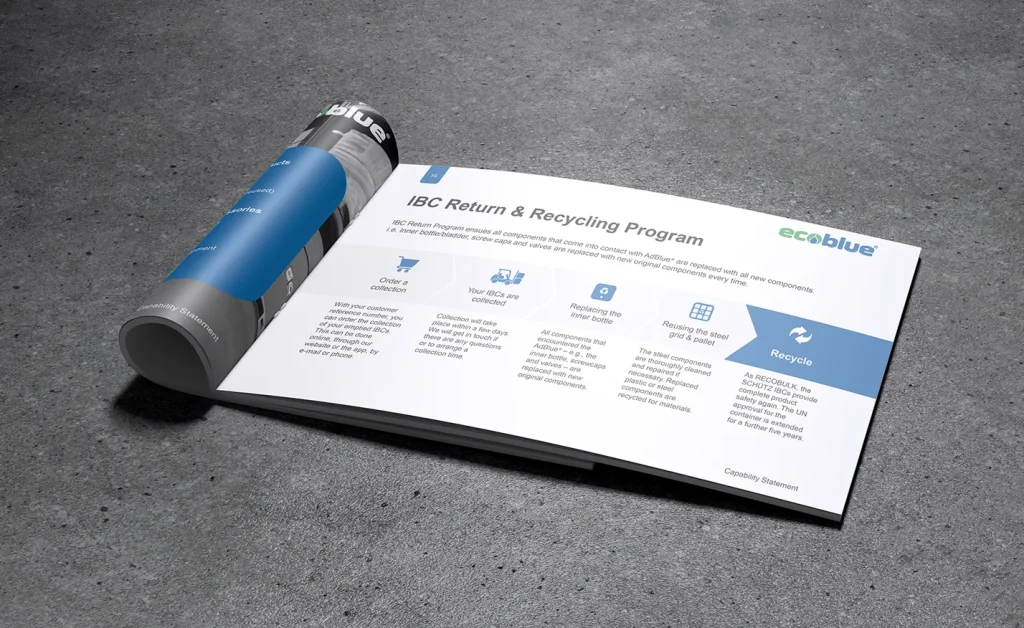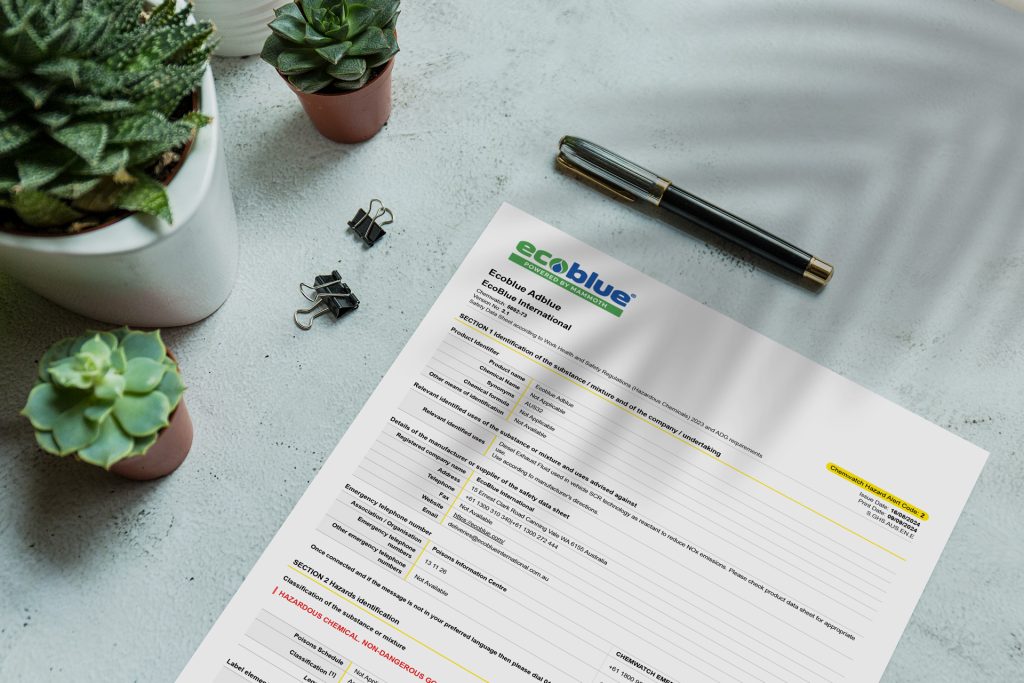
Downloads

At Ecoblue, we provide a range of valuable resources to support our customers and partners. From detailed product specifications to important safety information, you’ll find everything you need to manage your AdBlue® needs efficiently.

Frequently Asked Questions

What is AdBlue®?

AdBlue® is a non-toxic aqueous solution, made of 32.5% high-purity urea and 67.5% deionised water. It is used in modern diesel engines to reduce harmful emissions, specifically nitrous oxide (NOx), through a process called Selective Catalytic Reduction (SCR).

  • How does AdBlue® work?
    AdBlue® is injected into the exhaust system, where it reacts with NOx gases, converting them into harmless nitrogen and water vapor.
  • Who owns AdBlue®?
    AdBlue® is a trademarked term owned by the German Association of the Automobile Industry Verband der Automobilindustrie (VDA), which ensures its quality and chemical composition. While AdBlue® is recognized globally, in the USA, it’s referred to as Diesel Exhaust Fluid (DEF), but the composition is the same.
  • Is AdBlue® compulsory?
    Yes, since 2011, emissions regulations in Australia require the use of AdBlue® for new on-road diesel vehicles. This is part of a global effort to reduce NOx emissions and air pollution. Modern diesel vehicles and machinery are programmed to run with AdBlue® to comply with these regulations.
  • What is a DPF?
    A Diesel Particulate Filter (DPF) is a crucial component alongside AdBlue® to capture carbon soot from diesel exhaust. Together, SCR and DPF systems reduce emissions by up to 99%, making modern diesel engines far cleaner.

How is AdBlue® Made?

AdBlue® is made from 32.5% urea and 67.5% deionised water. The manufacturing process follows ISO 22241 standards to ensure the highest quality.

  • What is the manufacturing process?
    Urea is dissolved in deionised water in heated tanks. The solution is then filtered and stored under strict quality control procedures. The water used is demineralized through ion-exchange resins, ensuring no impurities affect the final product.
  • Why is quality control important?
    AdBlue® is manufactured according to ISO 22241, which ensures product consistency. The standard covers raw materials, testing, transportation, and storage, so you can rely on AdBlue® for its purity and effectiveness.

Benefits of Buying Bulk AdBlue®

Buying bulk AdBlue® offers numerous advantages for businesses with diesel-powered vehicles or equipment:

  • Convenience
    Bulk AdBlue® storage minimizes deliveries and invoices, and telemetry systems provide 24/7 access to monitor usage.
  • Reliable Supply
    For remote sites or large fleets, bulk AdBlue® ensures a steady, reliable supply with real-time level tracking.
  • Cost Savings
    Bulk purchasing cuts costs by reducing packaging and frequent deliveries. Since AdBlue® has a 12-month shelf life, you don’t need to worry about rapid consumption.
  • Environmental Impact
    By purchasing in bulk, you minimize road deliveries and reduce packaging waste, helping your business be more sustainable.
  • Peace of Mind
    With bulk tanks and telemetry, your site will always have the right amount of AdBlue®, avoiding any risk of running out.
    Reduced risk of Contamination from environmental issues

How do I best store AdBlue®?

Proper storage of AdBlue® ensures product quality and safety. Factors to consider include:

  • Usage Needs
    For usage under 1000L/month, IBCs and drums are ideal. For larger fleets, dedicated AdBlue® tanks from 2500L and up are more efficient.
  • Convenience & Control
    Larger tanks with telemetry systems offer 24/7 access and precise usage tracking, making them ideal for businesses with ongoing needs.
  • Temperature & Contamination Prevention
    AdBlue® should be stored between -5°C and 30°C. Tanks with insulated or heat-guarding options are recommended for harsh climates to maintain product integrity and prevent contamination.
  • Safety
    While AdBlue® is non-toxic, proper handling, storage, and dispensing systems ensure minimal exposure and risk of spills.

Is AdBlue® Compulsory in Australia?

AdBlue® is essential for reducing NOx emissions in modern diesel vehicles and machinery. In 2011, the Australian government introduced strict emissions regulations for new vehicles, making AdBlue® a necessary component for compliance with these standards.

  • Is AdBlue® mandatory?
    While not technically compulsory, SCR systems using AdBlue® are the only technology capable of meeting the strict emissions limits. This makes AdBlue® vital for compliance with ADR 80/03 for heavy vehicles and ADR 79/04 for light vehicles.
  • Are new vehicles equipped with SCR systems?
    Yes, commercial diesel vehicles come with SCR systems and are designed to use AdBlue® to meet emissions standards.

Is AdBlue® Hazardous?

AdBlue® is non-hazardous, safe to use, and classified as non-dangerous by both the Australian Dangerous Goods and NOHSC criteria. Though it should be handled with care, it doesn’t pose a significant risk to human health or the environment.

  • Storage and Handling
    While AdBlue® can be corrosive to some metals, it is non-combustible and poses no fire risk. Small spills can be cleaned up with water, and minimal contact is required to avoid irritation.
  • Environmental Impact
    AdBlue® is not hazardous to the environment, but safe storage practices help prevent spills and contamination.

What is AUS40?

AUS40 is a higher-concentration Diesel Exhaust Fluid (DEF) used in marine engines and large fixed plant machinery. It contains 40% urea, compared to the 32.5% in AdBlue®, to meet the higher demands of marine and power generation engines.

  • How is AUS40 different from AdBlue®?
    AUS40 is designed for marine applications or high-load machinery that require more urea to perform optimally under extreme conditions.
  • Is AUS40 compulsory?
    While not explicitly required in all regions, AUS40 is necessary for marine vessels in Emission Control Areas (ECAs) and for large engines under heavy load.

What does “SCR 40 compliance” mean?

1. What does “SCR 40 compliance” mean?

SCR 40 refers to Australian Design Rules (ADR) 80/4 and equivalent emissions standards that align with Euro VI or US EPA 2010 standards for heavy vehicles.

Key obligations for compliance:

  • NOx Reduction: Use of Selective Catalytic Reduction (SCR) to reduce nitrogen oxides.
  • AdBlue® or DEF Use: Required as a urea-based additive to support SCR systems.
  • Emissions Control Technology: Must include exhaust after-treatment, DPFs, and NOx sensors.
  • Vehicle Certification: Must be certified to a compliant standard before registration or sale.
  • Tamper Evidence: Onboard diagnostic systems (OBD) must detect and report system bypass or failure.

2. Proof of Certification

Entities must be able to demonstrate that:

  • The vehicle or engine has type approval under a compliant emissions regime (e.g., Euro VI).
  • The SCR system is functional, traceable, and supported by:
    • Compliance plate or ADR approval documentation.
    • Regular service records showing use of certified urea solution (e.g., AdBlue® / ecoblue).
    • NOx sensor and OBD reporting capabilities.
  • A DEF supply chain (e.g., ecoblue) is in place with documented ISO 22241 compliance.

3. Ecoblue’s Readiness

Ecoblue is fully compliant and ready to support SCR 40 conversion and operation through:

  • ISO 22241-compliant AdBlue® production and distribution
  • Australian-sourced product aligned with local quality and delivery needs
  • National logistics capability with refills, bulk supply, and IBC servicing
  • QR-coded traceability for proof of supply and quality chain
  • Support for fleet conversions, including education, onboarding, and documentation
  • Client resources including MSDS, usage manuals, and proof of compliance packs